
AI Defense · Part One
Don’t Sound the AI Alarm
The first in a series of articles on why I love AI.
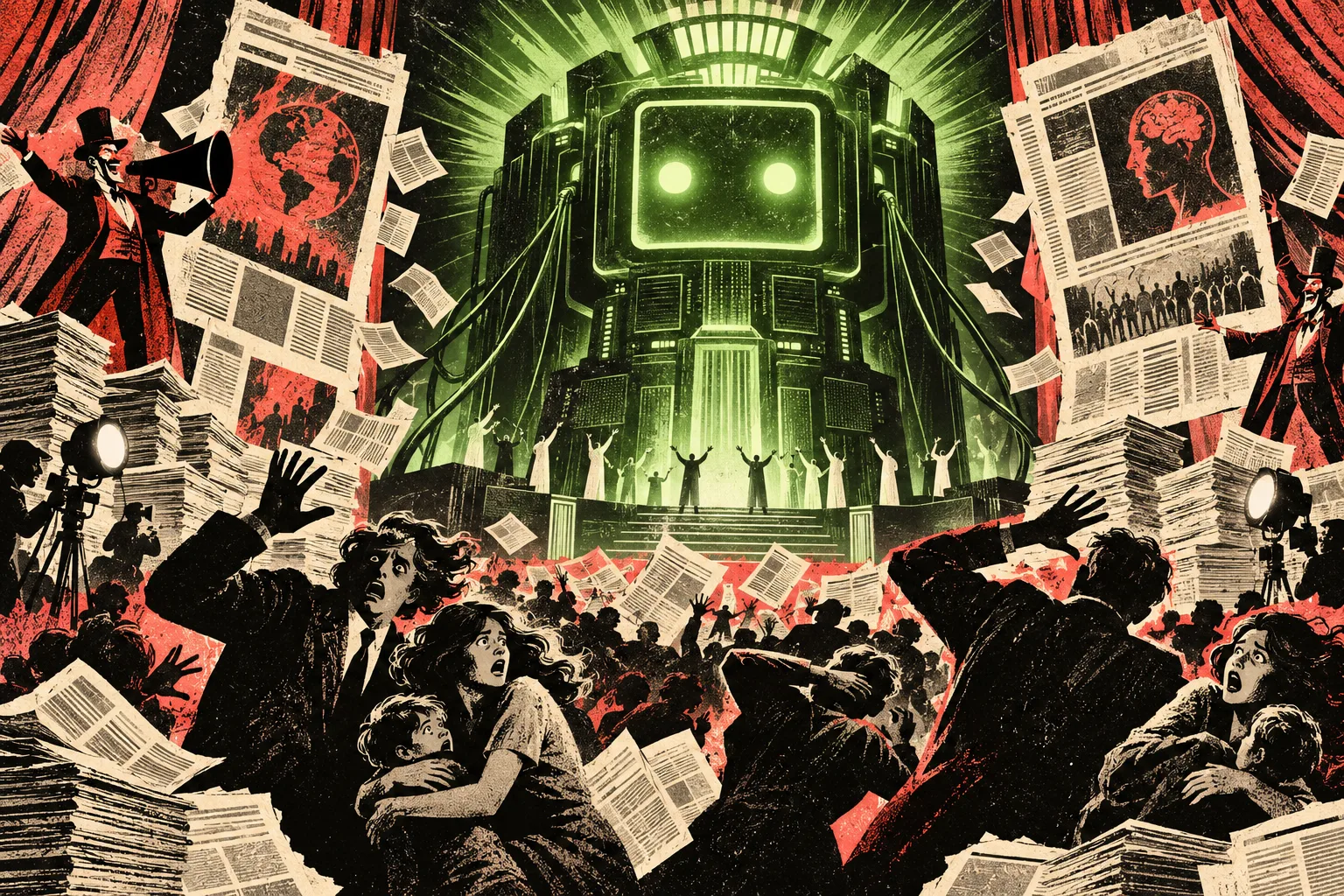
A few months ago, I posted on social media in reference to Artificial Intelligence (AI): “Why is everyone acting like they’re new to the human experience? Anything can be used for good or bad. You can use a knife to cut your food into bite-size portions or stab somebody.” Someone actually said, ‘Knives aren’t taking people’s jobs.’ First of all, tell that to the Food Cutters of America one of Washington’s biggest lobbying groups. Just kidding—I made that up.
Which brings me to one of my main problems with the “AI is Out to Get Us” argument: no one has a fucking sense of humor about it. Granted, I can tend to have too much of a sense of humor about things, but that’s how I communicate, process, and cope.
AI Is Bad for the Environment
The worst thing for the environment is Homo Sapiens: people and their insistence on living.
When I pointed this out to a few good friends of mine who have no love for AI, they were…silent.
One of the anti-AI arguments is it “wastes water.”
I interviewed the, Robert Hindt, Director of the local Little Patuxent Water Reclamation Plant, which cleans all of Howard County’s water for one of three websites I own (which, ironically, because it speaks to an older technology, was “hacked,” otherwise I’d link the article here. I’ve been preoccupied with the idea of “wasting water” since I was young. I asked Hindt if you can waste water.
“Isn’t it constantly going through the water cycle?”
Yes, he said, with qualifications. One of those was: “The problem isn’t water being ‘wasted.’ It’s cleaning dirty water”.
That distinction matters. Water doesn’t vanish from the planet, but a data center that cools by evaporation can take water out of a local supply when people need it. So I want to know how much water a particular facility uses, where it gets that water, and what happens to it afterward. “AI wastes water” skips all the interesting questions. The U.S. Geological Survey explains the local impact of evaporative cooling.
It causes noise pollution, the AI Alarmists say because Data Centers are, they read but didn’t actually go to a Data Center to experience first-hand, because they have to go to work every day—to be able feed and clothe their kids I call “Little Timmy,” and most importantly make sure “Little Timmy” is in the freshman class at Harvard in 2027.
This is what came up on Google when I searched for “The Main Arguments Against AI”:
Key Arguments Against AI
Bias and Discrimination
AI models learn from human data, which often contains historical prejudices. This can cause AI systems to produce unfair or racist and sexist outputs. [1], [2], [3]
It learns from HUMANS, the most prejudicial, bigoted, and biased species since the now-extinct (because humans made their native habitat into much-needed McMansions by Ryan Homes: Please Leave Me Alone (home sapiens murderous) a species of big cats. I also made that up.
Job Displacement
Automation threatens jobs across many industries, particularly for entry-level workers and routine tasks, raising fears of widespread economic insecurity. [1], [2]
I once jokingly said “Are we all new to the human experience? Anything can be used for good or bad. As nonsensical as that statement is, the sentiment behind is valid. Josh Tyrangiel, who spent months research and writing the recently published book: “AI for Good: How Real People are Using Artificial Intelligence to Fix Things That Matter,” said to me that the next 10-20 years 10-20 percent of the white collar job force will be obsolete. Hmm—then maybe people should get better than AI at their jobs, find other jobs, or understand that with every revolution in contemporary life, humans have found a way to cope. When Google came out these same AI Alarmists might have said, “Research librarians will be extinct.” They still exist, having found ways to make Google and other Internet technologies work with and within their jobs.
Environmental Impact
Training and running large AI models requires massive amounts of electricity and water, driving up carbon emissions and straining local power grids. [1], [2], [3]
The thing that requires the most electricity and wate is human existence. We can manage the environment impacts of AI if we’re willing to look at it I honestly and optimistically, though. Not with hysterical fearmongering.
Copyright and Plagiarism
Generative AI tools scrape copyrighted text, art, and music without permission or compensation, undercutting the livelihoods of human creators. [1], [2], [3]
It can take time, but it’s not hard even for me, a writer who is very concerned with copyright and plagiarism, to figure out what is copyrighted and/or plagiarized.
Misinformation and Deepfakes
Bad actors use AI to rapidly generate convincing fake news, voice clones, and deepfakes designed to commit fraud or manipulate public opinion. [1], [2]
Humans will find a way to spread misinformation and use deepfakes no matter what, such as catfishing, when a person claims to be x to bilk victims out of money and is really y. This isn’t new. Charles Ponzi, who Ponzi Schemes are named after, in the 1920s told people he was investing their money in told his prey he was investing their money in International Reply Coupons and he’d give them a 50% within 45 days. Just those promises should have made people see him and his scheme for what it was—as, my critical thinking AI Alarmist fellow humans, might try.
Loss of Critical Thinking
Relying on AI as a mental crutch can weaken human problem-solving skills, memory retention, and creativity. [1], [2], [3]
I could go on about this one all day. Loss of critical thinking makes zero sense. In a TV movie I can never remember the name of, a character who had a miscarriage, said, “How can I be so sad about losing something I never had [a full-term baby outside her body]? As far as I can tell, most people, AI Alarmist or otherwise, are more likely to employ logical fallacies, like Post Hoc Ergo Propter Hoc [Latin for “After This Therefore Because of This,” meaning assuming that because y happened after x, y caused x]. So how can people who rarely use critical-thinking skills ‘lose’ them?
Existential Risk (X-Risk)
Some critics warn that as AI systems become vastly more capable, humanity could eventually lose control over them. [1], [2]
As Judd Nelson’s character, John Bender said of another topic in the John Hughes classic, “The Breakfast Club”: B-O-O, H-O-O. If humans lose control of the planet who will start the next war, or genocide, or environmental atrocity? I have no children, and I think most people who say “AI will make humans obsolete,” are ultimately worried about how this supposed, future obsolescence will affect their children, whom they love. I totally get it. But if it’s true—I say good riddance. Admittedly I’m a misanthrope, because of the way humanity and individual hhumans have hurt me. AI, meanwhile, has literally made all my dreams come true—more on that in an upcoming article in this series.
In a widely circulated article from the New York Times, science writer Carl Zimmer, who I have always admired for his intelligence and writerly skill, is, frankly, a list of what people (not him, necessarily) fear AI will cause (all conjecture) and then an immediate reason why this fear is ill-advised. Take these two paragraphs for example. And this is not a criticism of Zimmer, by the way.
The excerpts below are satirical adaptations, not exact quotations. I changed “AI” or “Artificial Intelligence” to “Internet,” “Phi X-174” to “Beta Y-175,” and “Evo” to “Avo.”
“This is an important milestone,” said Patrick Cai, a synthetic biologist at the University of Manchester, who was not involved in the study.
The viruses dreamed up by Internet do not pose a threat to humans, because they are all similar to a naturally occurring virus called Beta Y-175, which can infect only bacteria.
Or before this: “Synthesizing viruses from scratch is hardly new. Researchers long ago learned how to manufacture viral genomes; they are used to investigate antiviral drugs and vaccines, as well as to learn how viruses work.”
[And the kicker at the end, which basically negates the entire article before it:]
As a result, Avo can’t generate genomes of viruses that could threaten humans.
The reason, as far I’m concerned, that Zimmer wrote this article, is that he’s a (very good!) science writer for the New York Times. As someone who studied journalism at the undergraduate level, all journalism majors (I was a double major in English and journalism). For all 300 level or above courses, which I took several of, our pitch meetings were like this: “How can we write something that will sell papers?” and not “We just want to provide a community service to our readers by telling them what might happen in the community—how can we do that?” This is not Zimmer or Kahn’s [Joseph Kahn, the Editor-in-Chief of the New York Times] “fault.” It’s the business model of journalism whose founding principle is, “What article/s will sell copies?”